How you come across at work, and someone to talk it through with.
A 360 puts how you see yourself next to how the people around you experience you, on behaviour they’ve actually observed. I design the round with you, coach you through it, and go through the report with you.
app.simonbowen.com
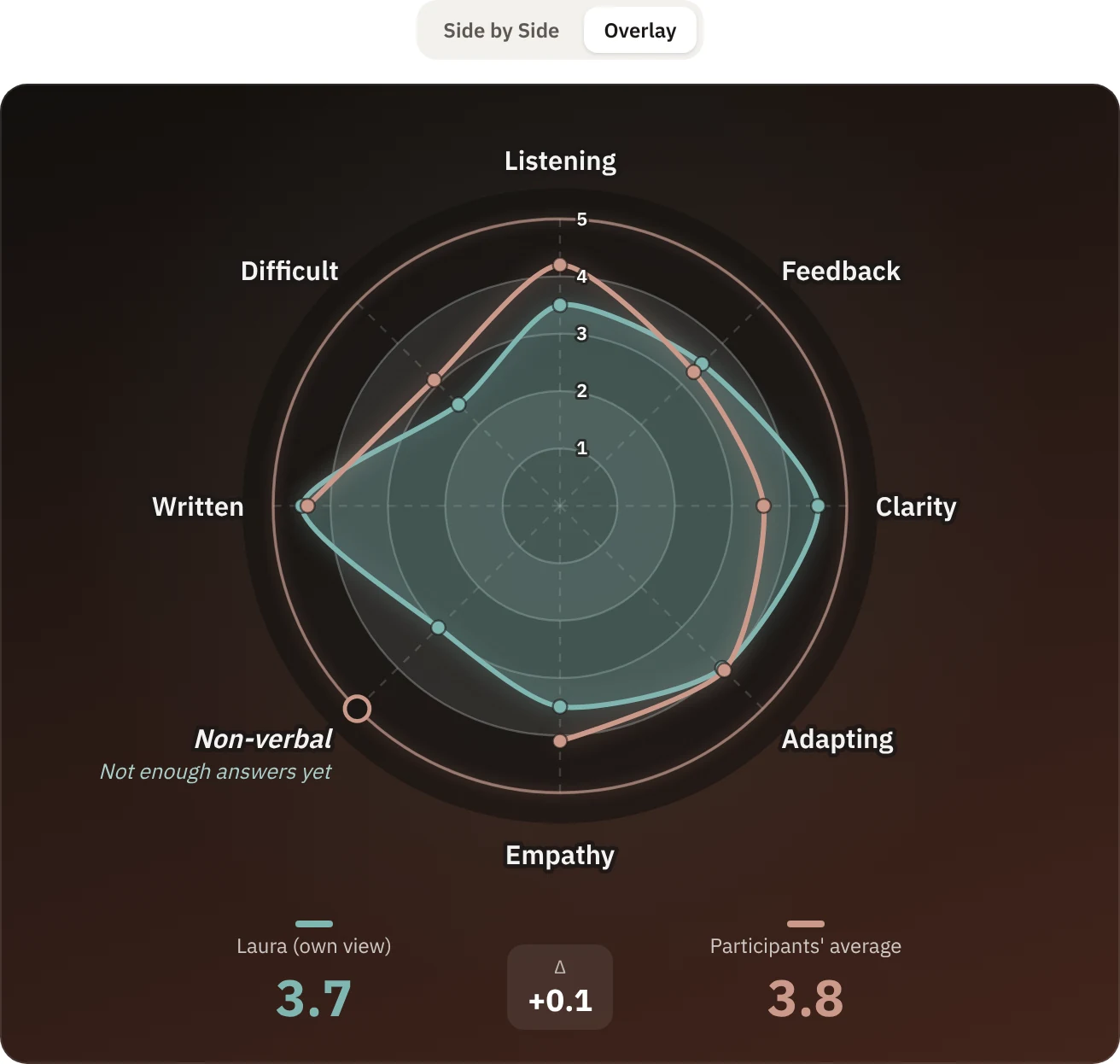
Demo data Your ratings and the raters’ average, in one view.
You answer a set of statements about how you work with other people. People you choose answer the same statements about you, one area at a time, rating only what they’ve seen. When the round closes, the answers are added together and the report puts the two views side by side.
1
You rate yourself
You go through the statements first, before anyone else is invited, so your own view is on record.
2
They rate you
The people you choose answer by email link. They need no account, and nobody reads a single answer.
3
The report compares the two
You see where your view and theirs match, where they don’t, and by how much.
Who it suits
When a 360 fits.
A bigger or changed role
In a new or changed role, the people around you are working out what to expect from you. A 360 shows you what they’ve seen so far.
A team or business that has outgrown what you can see
As a team or business grows, you’re in fewer of the conversations that decide how you’re seen. A 360 gives you the view you no longer get first-hand.
Something has already gone sideways
People leave, clients go quiet and working relationships sour, often without anyone saying why. A 360 can show whether you’re looking at a pattern in how people experience you or at a single case.
A 360 is for the person it’s about. It isn’t a performance review, I never pass a report to an employer, and with no benchmarks it can’t tell you how you rank against other leaders. It sets your own view beside the view of the people you choose to ask.
What you get
Your view and theirs, side by side, and a debrief to go through it.
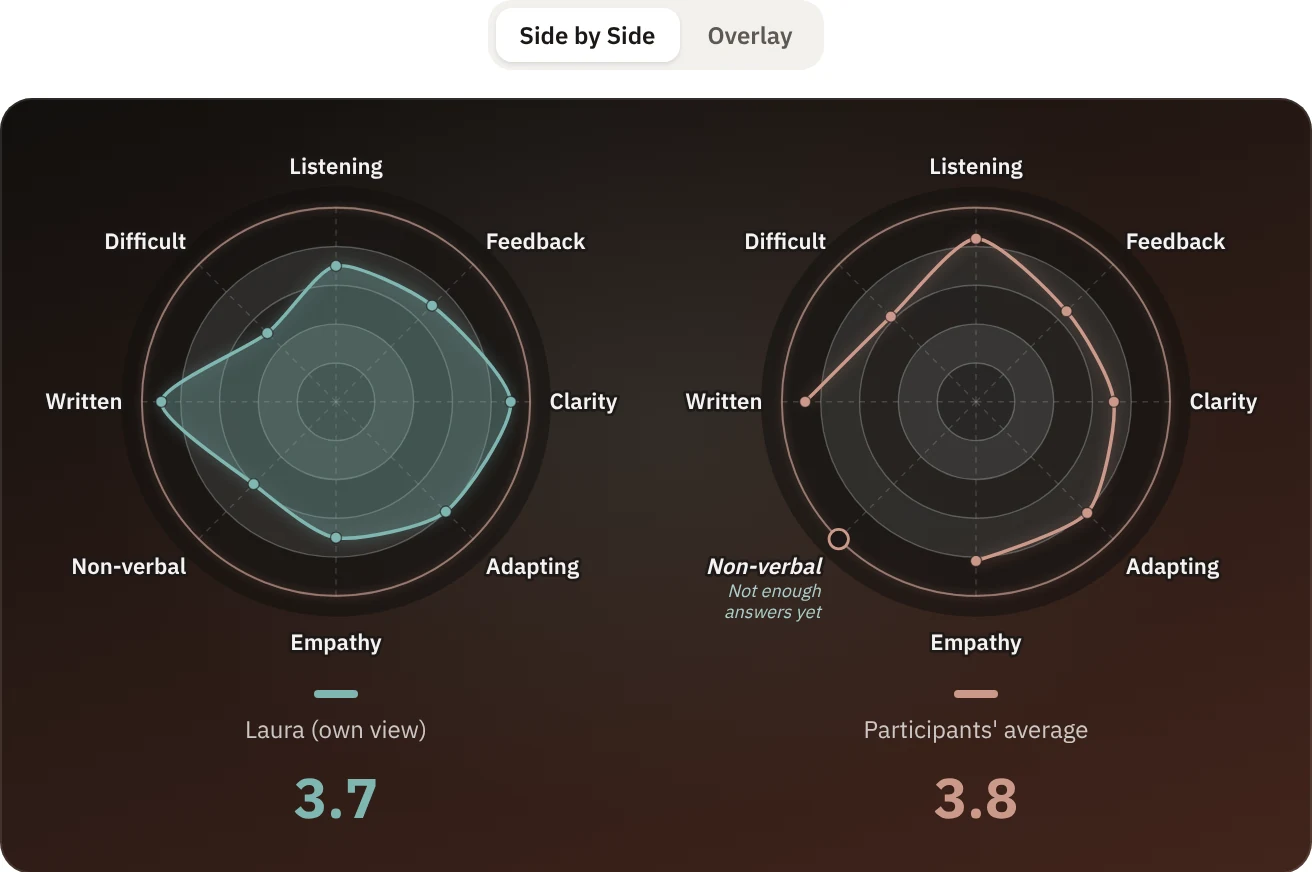
Your view and theirs in one chart. Overlaid, or side by side, across the areas of behaviour your round covers, each one something other people can observe.
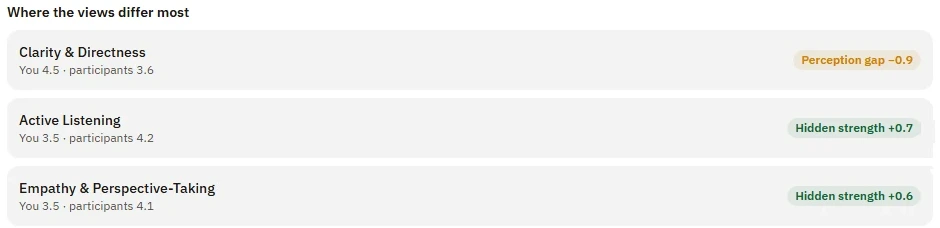
Perception gaps and hidden strengths. Where others rate you lower than you rate yourself, the report shows a perception gap. Where they rate you higher, it shows a hidden strength.
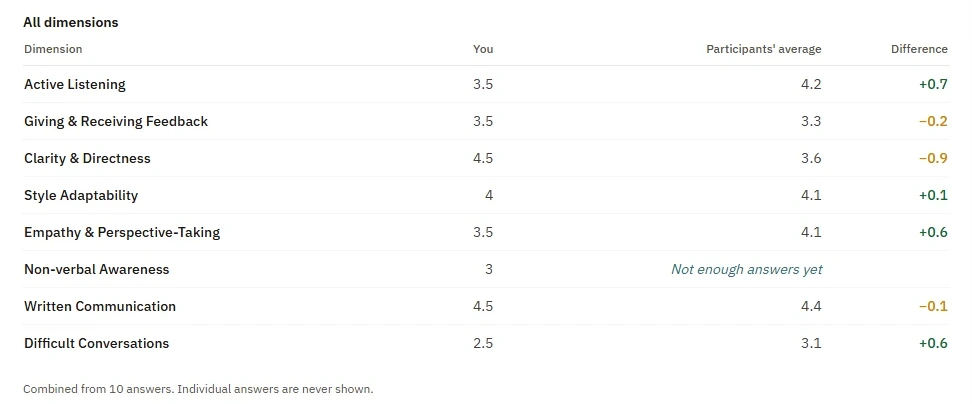
Every area in a table. Your rating, the raters’ average and the difference, for every area your round covers.
A report you keep. It reaches you as a PDF in my brand, handed over in the debrief, with my written observations alongside the results.
Your question shapes the round, and we go through the results together.
Built around your question
In scoping we decide what you want to find out and from whom. The questions are chosen or written for that, and I set the round up myself. There is no generic report.
Guided and supported throughout
We talk before the round opens, I check the results before you see them, and we go through them together in a 60-minute debrief, with a follow-up session after that. You’re never handed a report and left to it.
My written observations
The report carries my written observations alongside your results, in a PDF in my brand. It belongs to you, and so does the conversation about it.
In their review of the field, Bracken, Rose and Church name the most common reason a 360 process fails:
Bracken, D. W., Rose, D. S. and Church, A. H. (2016), “The evolution and devolution of 360° feedback”, Industrial and Organizational Psychology 9(4), 761–794. doi.org/10.1017/iop.2016.93. The quoted words are from the section on what the authors would say is the most common reason a 360 process fails. They also criticise handing a leader a report with no follow-up support.
That is the part I’ve built the offer around: a 60-minute debrief, then a 60-minute follow-up session.
You own the result. It reaches you only when I publish it. It never goes to an employer.
Nobody reads a single answer. An area appears only once at least three raters have rated it, and that applies to me as well.
No benchmarks. Your results are compared with the people who rated you, not with a database of other leaders.
Who you’d be working with
Coach and mentor holding the EMCC Global Individual Accreditation (EIA) as a Practitioner, with clients since 2008. I also founded and scaled a software company, successfully sold it in 2022 and stayed with the buyer until February 2024.
The fee includes three hours of one-to-one sessions with me: a 60-minute scoping session, a 60-minute debrief and a 60-minute follow-up. Further scoping sessions are billed at the session rate shown under the fees, so a round with one extra scoping session is four hours.
How a round runs
From the first call to the follow-up.
Six steps. You can see what you’ll see at each one, on demo data from the app.
01
The first conversation
The first conversation is a free discovery call of up to 45 minutes, by video from anywhere or in Berlin by arrangement.
What we talk about
You tell me what you’d like to find out about how you work with other people, and I tell you whether a 360 is a good way to find it out. If it is and you want to go ahead, I send an invoice. There is no payment on this website and nothing to enter.
02
Scoping
One scoping session is included in the fee. Any extra scoping session is billed as a session.
How scoping works
We work out what you want to find out, from whom, and what the questions should cover. The questions come from an instrument built for behaviour other people can observe, or, if none fits, from one I write for your round. The screens on this page show one example.
The rate for an extra session is under the fees, so you know what one costs before you decide.
app.simonbowen.com
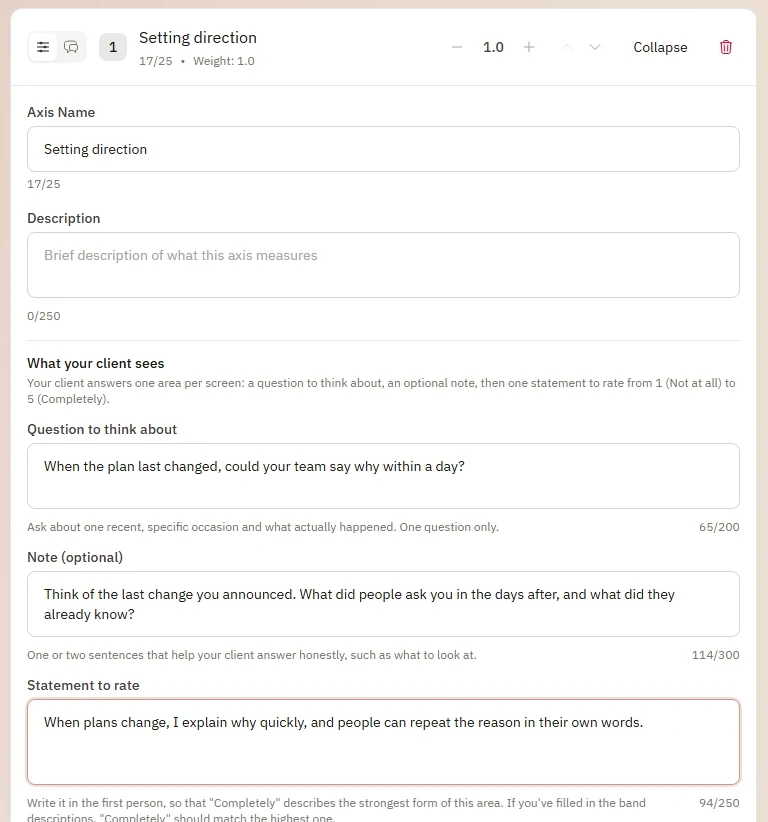
Demo data Writing an instrument for one round: the editor.
A question about a recent occasion. Raters are asked what actually happened, not what they think of you in general.
An optional note. It helps the rater answer well, for example by saying what to look at.
A statement to rate. Written in the first person, with 1 being not at all and 5 completely.
03
Your round
After scoping I set the round up for you, and you rate yourself first.
How the round is set up
You answer the same statements your raters will, one area to a screen, before anyone is invited. That puts your own view on record before you see anyone else’s.
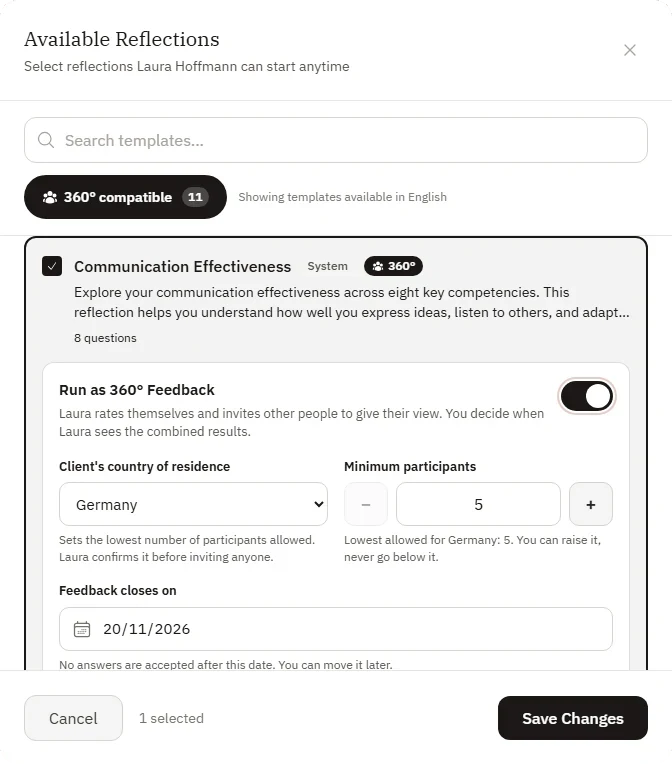
Demo data Setting the round up, from my side.
The minimum follows your country. For Germany it is 5. I can raise it, never lower it.
A closing date. Between one and eight weeks ahead, which I can move later.
You’re told when it’s ready. Then you start with your own reflection.
app.simonbowen.com
Demo data Three steps: your own reflection, how the feedback is used, and the invitations.
app.simonbowen.com
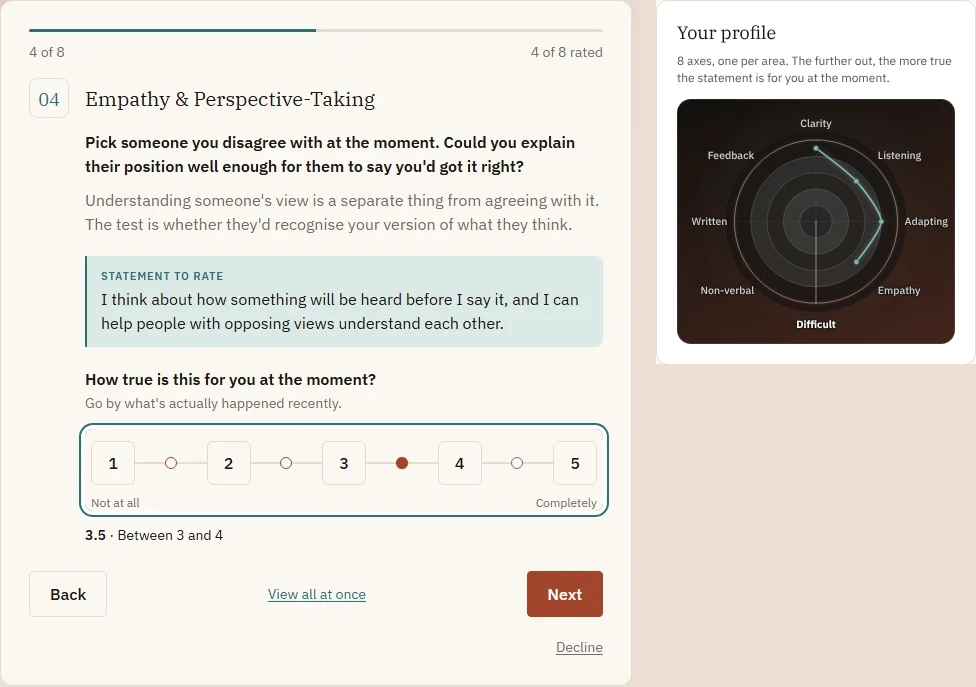
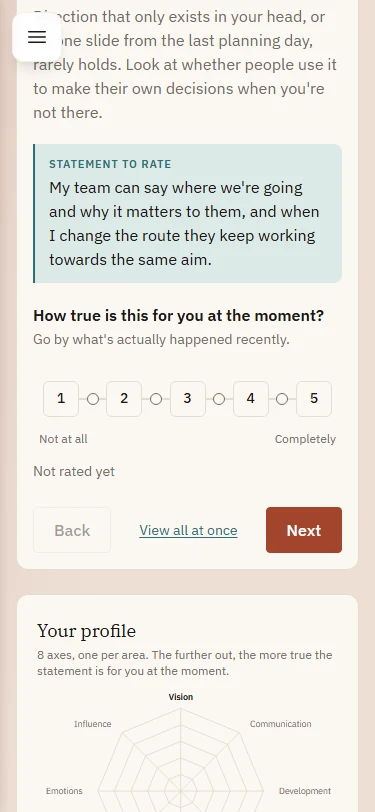
Demo data Your own reflection, one area to a screen.
One area at a time. A question to think about, a note, then a statement to rate.
1 to 5, in half steps. Nothing is pre-filled, so an area you haven’t rated stays unrated.
Your profile fills in as you go. One axis per area: the further out, the more true the statement is for you at the moment.
04
Your raters
You invite the people you’d like to hear from, and each of them answers in a few minutes.
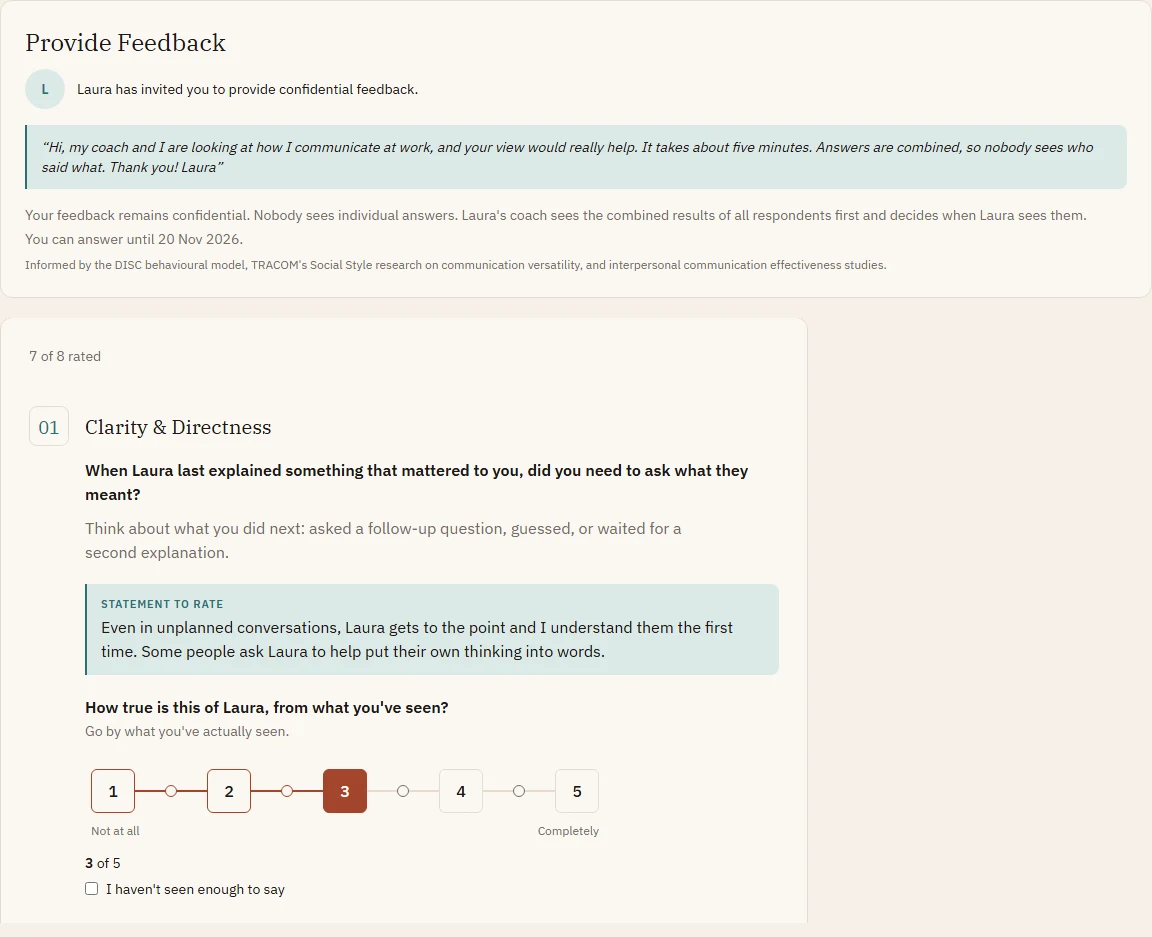
What your raters see
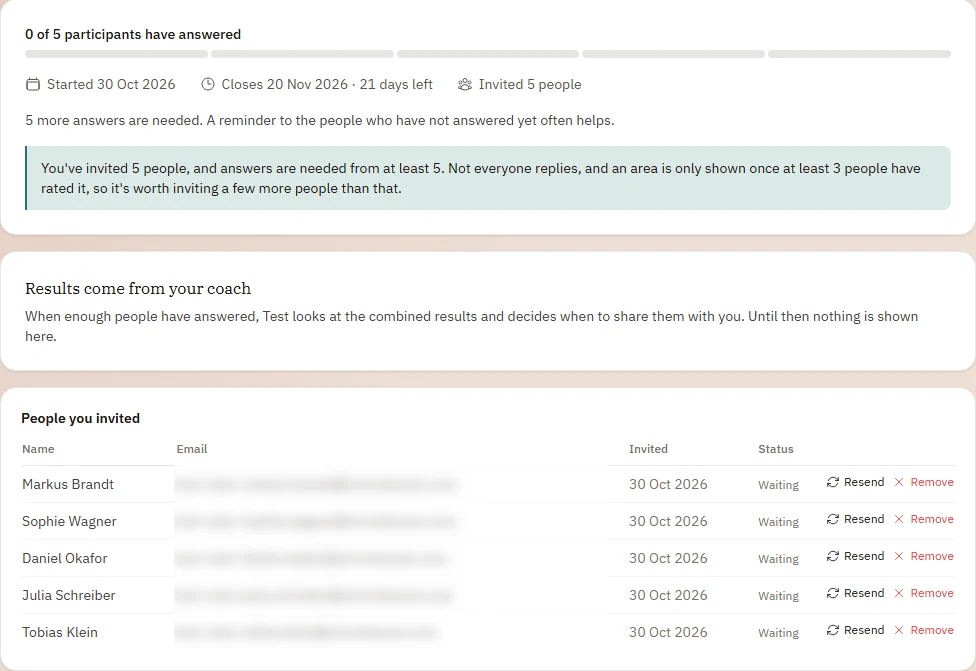
Each rater gets a link by email and rates what they’ve seen on a scale of 1 to 5, in English or in German. Where they haven’t seen enough to say, they tick a box. There is no place to type a comment, so a rater gives ratings and nothing else. Your round page shows how many answers are in, who hasn’t answered yet, and when the round closes. You see who has answered, never what they said, and you can send a reminder or withdraw an invitation. The page shows the minimum number of answers a round needs, and not every invitation gets one.
I see counts and dates, never who was invited or who answered, and nobody reads a single answer. Every rater is told that before they start.
app.simonbowen.com
Demo data Your round page: who you’ve invited, how many answers are in, and when it closes.
app.simonbowen.com
Demo data What a rater sees, in English, and the rating screen on a phone.
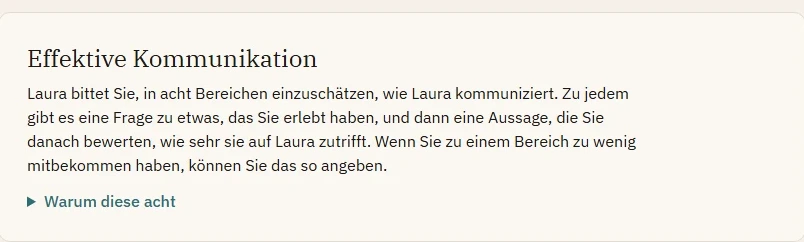
Demo data The introduction to the instrument, in German.
Each rater chooses their language. English or German, formal or informal.
The promise comes first. Nobody sees individual answers, and I see the combined results before you do.
No account needed. They answer from the link in their email.
How many people to ask, and whether raters need an account, are answered under Questions.
05
The report
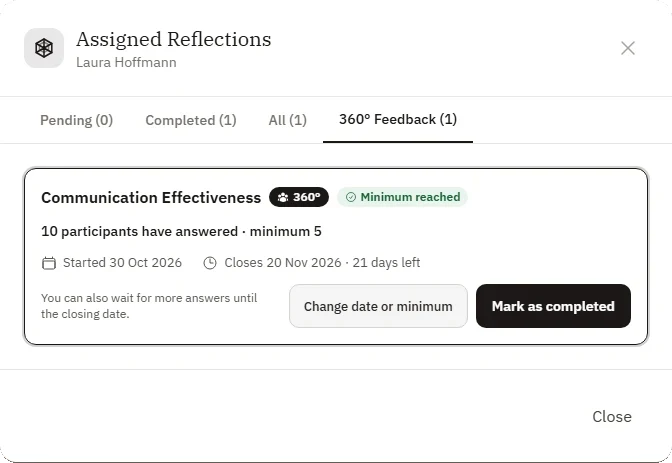
When enough people have answered, I check the results first, and I publish them to you.
How the results reach you
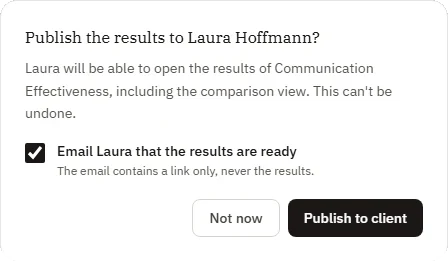
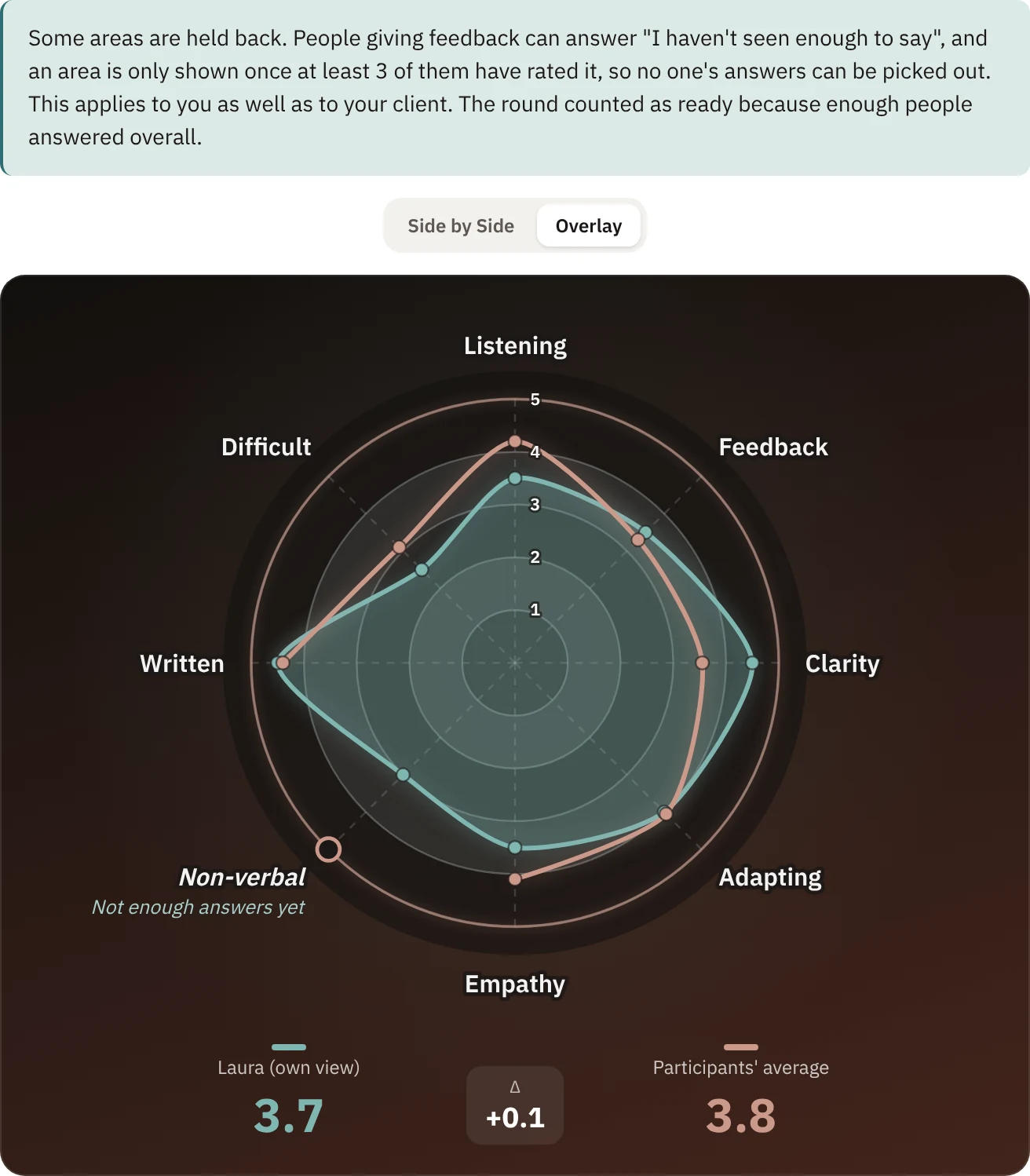
The same held-back rule applies to me as to you: an area appears only once at least three raters have rated it, so one rater’s answers aren’t shown on their own. Nothing appears in your account until I publish, and the email telling you it’s ready holds a link, never the results. You can open the comparison view in the app, and in the debrief I hand you the report as a PDF in my brand, with my written observations alongside the results.
Demo data My side: once the minimum is reached I decide when the round closes.
Demo data Nothing reaches you until I publish. The email holds a link, not the results.
Demo data My comparison view, with the same held-back rule.
Held back for everyone. The note applies to me as well as to you.
A gap on the chart. The area is marked as not enough answers yet.
06
The debrief
We spend 60 minutes on the report, and a further 60 minutes in a follow-up session.
What we go through
The first session goes through it area by area, starting wherever the gap between what you said and what they said is widest. The follow-up is for what you’ve done with it since, and for what you’ve noticed when you’re next with the people who rated you.
If an organisation is asking
The organisation commissions the round. Each person receives their own report.
Raters are chosen by the subject
Each subject picks their own raters and sees their own report. The organisation has no account on the site.
Results go to the person assessed
I never pass a report to the organisation, and that includes a line manager or HR. Whether to share it with their employer is the choice of the person it’s about.
The works council is part of the design
In a German organisation with a works council, a feedback round can touch the council’s rights. We go through that in the design conversation, before an invitation goes out. The guide: 360 feedback and the works council.
Prices for businesses and organisations exclude VAT, which is added at 19%. Prices for private individuals include it. Each one is shown beside the time with me that it buys.
For you, as an individual
One 360 round
€1,428including 19% VAT for a private individual
€1,200 excluding VAT
This covers
60 minScoping with me, the first session
SetupThe round, built from what we agreed in scoping
RatersChoosing your raters with me, and keeping the round moving until it closes. The fee doesn’t change with the number of raters you invite.
ReportYour report, published when I’ve checked the results
One scoping session is included. If we need more, each extra one is billed as a session: €214.20 including VAT (€180 excluding) if you pay personally, €250 excluding VAT if your business or organisation pays. With the debrief and follow-up, that’s three hours with me in the fee.
For six people the total starts at €7,000 excluding VAT: a design fee from €1,000, plus €1,000 for each person assessed. The final design fee depends on the agreed scope.
The design fee covers designing the round with you, including one 60-minute scoping session. An extra scoping session is billed as a session, at €250 excluding VAT.
Each fee covers one round on one instrument. If you’d like to run more than one round, ask me for a price.
How billing works
There is no payment on this page and no card to enter. After our discovery call, once you’ve decided to go ahead, I send an invoice. A private individual has a statutory right to withdraw within 14 days of agreeing, and I send the withdrawal information and form with the confirmation, before anything is paid. If you ask me to start within those 14 days, you pay for the work done up to the point you withdraw, in proportion to the full price.
Questions
Questions about the 360.
Is this a performance review?
No. The report is for the person it’s about, and I never pass it to an employer. There are no benchmarks, so it can’t rank you against other leaders.
How long does a round take?
Raters have between one and eight weeks to answer, set when we plan the round. The scoping comes before that, and the debrief comes once the round has closed. The steps are set out under How a round runs.
Who sees my raters’ answers?
Nobody reads a single answer, including me. The answers are added up when the round closes, and you see the totals once I’ve published them. The report step shows how.
Can raters write comments?
No. Raters give ratings, and can tick that they haven’t seen enough to say. There is no box for a written comment.
Is an AI tool used on the answers?
No. Raters’ answers are added up by the platform and are never sent to an AI tool.
What if too few people answer an area?
It’s held back and shown as a gap. An area needs at least three ratings to appear.
Can I run more than one round?
The fee covers one round on one instrument. If you’d like to run more than one, ask me for a price.
How many people do I ask?
A round needs a minimum number of answers, which depends on your country: five for Germany. We settle how many people to ask in scoping, and step 4 shows what your raters see.
Does the fee change with the number of raters?
No. The fee doesn’t change with the number of raters you invite. The fees show what each one covers.
Can my raters answer in German?
Yes. Each rater answers in English or German, whichever they prefer, in the formal or the informal form. The debrief is in English.
Do raters need an account?
No. They open their link and answer on a phone or a laptop.
Is VAT included?
For a private individual, yes: €1,428 for one round and €214.20 for an extra session, both including 19% VAT. For a business or organisation the prices exclude VAT, and 19% is added to the invoice.
How do I pay?
By invoice, after the discovery call and once you’ve decided to go ahead.
Does a works council need to be involved?
In a German organisation with a works council, a feedback round can touch the council’s rights, depending on how the round is set up. We go through that in the design conversation, before an invitation goes out. 360 feedback and the works council covers what the law gives a council.
What happens to my data?
The privacy policy explains how personal data is handled and names the processors. Read it here.
Discovery call
Tell me a little, then pick a time.
Two quick questions, then my calendar. We spend 45 minutes finding out what you need and whether I’m the right person for it.
The people who would each receive a report. A rough number is fine.